Few soldiers in history look as spectacular as the Polish winged hussars. Heavy cavalry in plate armour, leopard skins over their shoulders, and tall wooden frames on their backs set with feathers, charging with lances nearly five metres long. They sound like something from a fantasy novel. They were real, and for well over a century they were among the most feared cavalry in Europe.
Who the Hussars Were
The husaria were the elite heavy cavalry of the Polish-Lithuanian Commonwealth. They developed in the sixteenth century from lighter Hungarian and Serbian horsemen and grew into armoured shock cavalry. Most hussars came from the nobility, and they paid for much of their own equipment, including their horses, which were bred for speed and stamina.
They were used for one thing above all: the charge. A hussar squadron would advance at a walk, break into a trot, and then into a full gallop over the last stretch, lances lowered, in close formation.
The Battles
Three battles made their name.
Kircholm, 1605. A small Polish-Lithuanian army, heavily outnumbered, defeated a much larger Swedish force in about twenty minutes, largely through the hussars' charges.
Klushino, 1610. Hussars broke a far larger Russian and Swedish army. The victory opened the way to Moscow.
Vienna, 1683. The relief of Vienna from the Ottoman siege ended with what is often called the largest cavalry charge in history, with the Polish hussars under King Jan III Sobieski at its head.
What They Carried
The lance, the kopia, was the hussar's first weapon. It was long, hollow and light for its size, and it was expected to break on impact. After it came the other arms.
The koncerz was a long, straight, stiff sword designed for thrusting, carried under the saddle. It could reach a man through the joints of his armour or be used almost like a short lance.
The szabla, the sabre, was worn at the side. The hussar sabre, szabla husarska, has a closed hilt with a knuckle guard and a ring for the thumb. That ring gave the fencer a great deal of control over the blade, especially for the quick wrist cuts and turns that make a sabre dangerous. It was a close-quarters weapon for when the lance was gone and the fight had become a mêlée.
Many hussars also carried pistols, a war hammer or an axe. They were equipped for every distance.
And the Wings?
Nobody is completely sure what the wings were for. Suggestions include making the rider look taller and more frightening, making a noise at the gallop that unsettled enemy horses, and protecting against lassos. They may simply have been a mark of an elite unit, the way some regiments today wear distinctive hats. In the earliest period they were fixed to the saddle; later they were worn on the back.
The Hussar Sabre Today
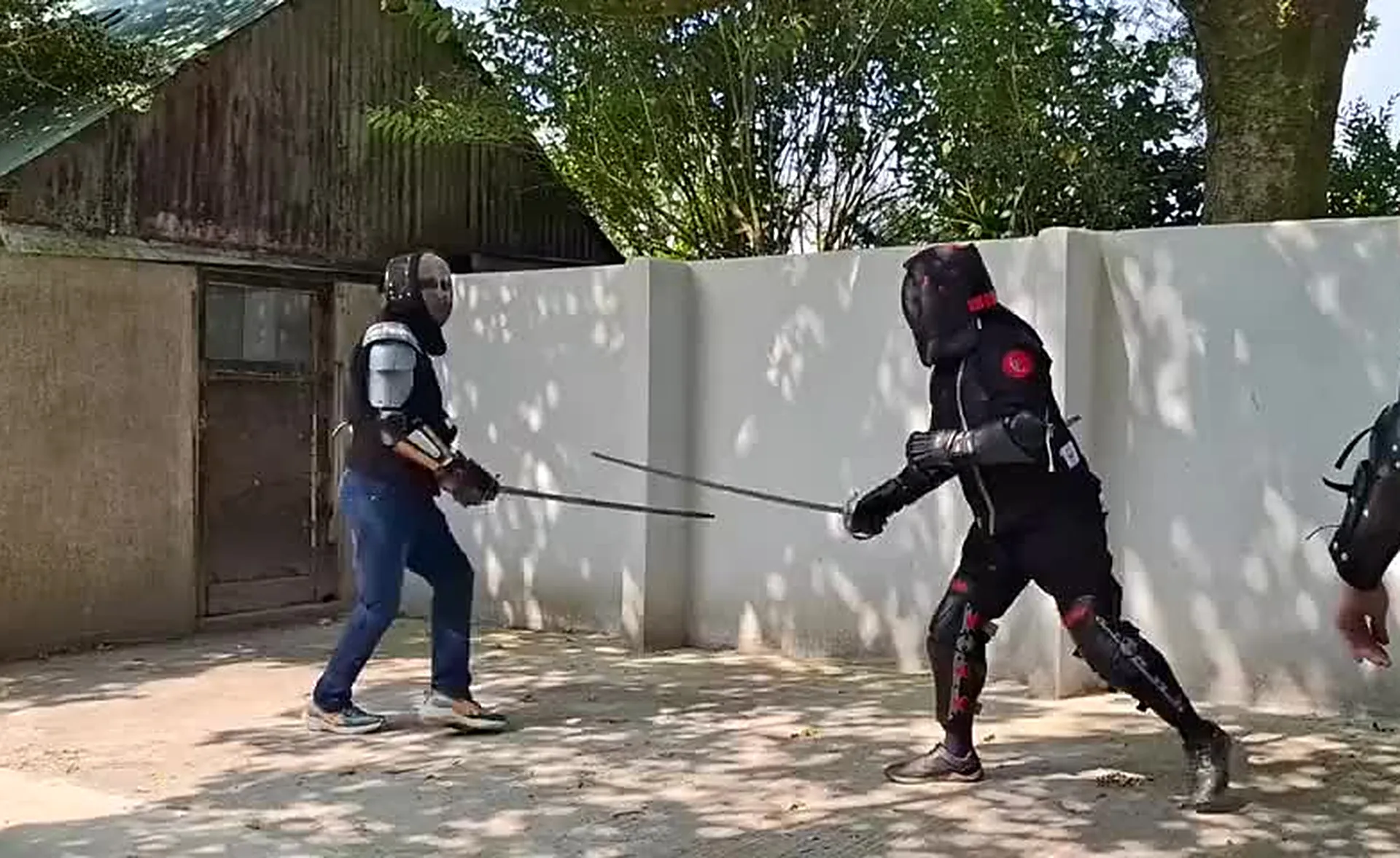
The fencing that goes with the Polish sabre has been reconstructed from the surviving sources, most notably by Akademia Szermierzy in Warsaw. At HEMA Penzance we train that reconstruction alongside Fiore's art, taught with our clubmate Jake's help, and we are learning it together. You can read more on our Polish sabre page and in a short history of the szabla.
No horse required. The club lends sabres and all the kit, and your first lesson is free.