For about three hundred years, if you met a Polish nobleman, he was wearing a sabre. It went with his clothes the way a watch goes with a suit now. It hung at his side at weddings, at the parliament, at the market, and in war. The Poles called it the szabla, and it became so tied up with who they were that the country's fencing tradition is still named after it.
Where the Szabla Came From
Curved swords came into Europe from the east. The Hungarians used them, the Ottoman Turks used them, and the peoples of the steppe had used them for centuries. Poland sat right on that frontier, and from the fourteenth century onwards the curved single-edged blade gradually became its sword.
By the sixteenth century the straight western sword had given way almost entirely. The szabla was light, quick in the hand, and very good on horseback, and a country whose armies were built around cavalry took to it completely.
The Forms It Took
Several kinds of Polish sabre have names of their own.
The Hungarian-Polish sabre of the sixteenth century has an open hilt with a simple crossguard. The batorówka, named after King Stefan Batory, who reigned from 1576 to 1586, is a well-known example.
The hussar sabre, szabla husarska, belongs to the seventeenth century and the famous winged cavalry. It has a closed hilt with a knuckle guard and a thumb ring, which gives the hand much more protection and more control. We have written about the hussars in our post on the winged hussars and their sabres.
The karabela was the dress sabre of the nobility, with a pommel shaped like a stylised eagle's head. It was worn with the long kontusz coat and the silk sash, and it was a symbol of the wearer's rank as much as a weapon.
How It Was Fenced
This is where things get difficult. Polish sabre was fenced for centuries before anyone wrote it down in a form that survives. The earliest surviving manuscripts documenting it are eighteenth century, which means historians have had to work back from illustrations and later texts to the art itself.
That reconstruction has been done in Poland in recent decades, most notably by Akademia Szermierzy in Warsaw, and the art they reconstructed is fenced there today. It is fast, it cuts from the wrist rather than the shoulder, and it keeps the fencer covered as they attack. It is also very different from the popular image of Polish sabre, which we talk about in the myth of Polish cross-cutting.
After the Commonwealth
The Commonwealth was partitioned by its neighbours at the end of the eighteenth century, and Poland disappeared from the map until 1918. The sabre did not disappear with it. It stayed in the hands of Polish soldiers who fought in other armies, and it remained a symbol of the country throughout the nineteenth century. The European sabre traditions that grew up in that century, and eventually Olympic sabre fencing, owe a good deal to this older eastern family of curved swords.
Polish Sabre in Cornwall
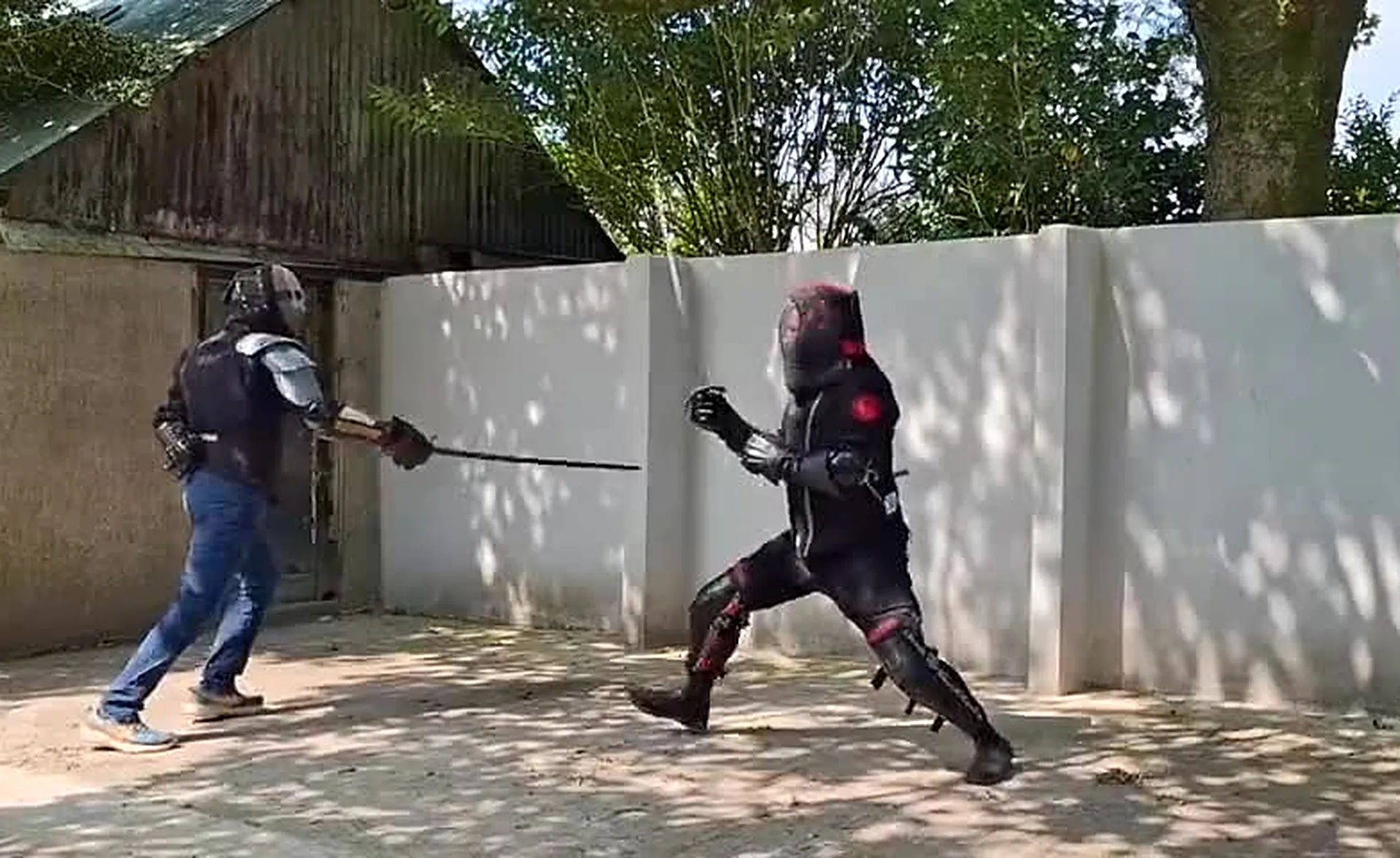
Since September 2026 HEMA Penzance has trained Polish sabre, as reconstructed by Akademia Szermierzy, alongside Fiore's art. It is taught with the help of our clubmate Jake, who spent a month learning it in Warsaw, and the club is learning it together. You can read more on our Polish sabre page.
The club lends steel sabres and all the protective kit, so if you are curious, come along on a Tuesday. Your first lesson is free.