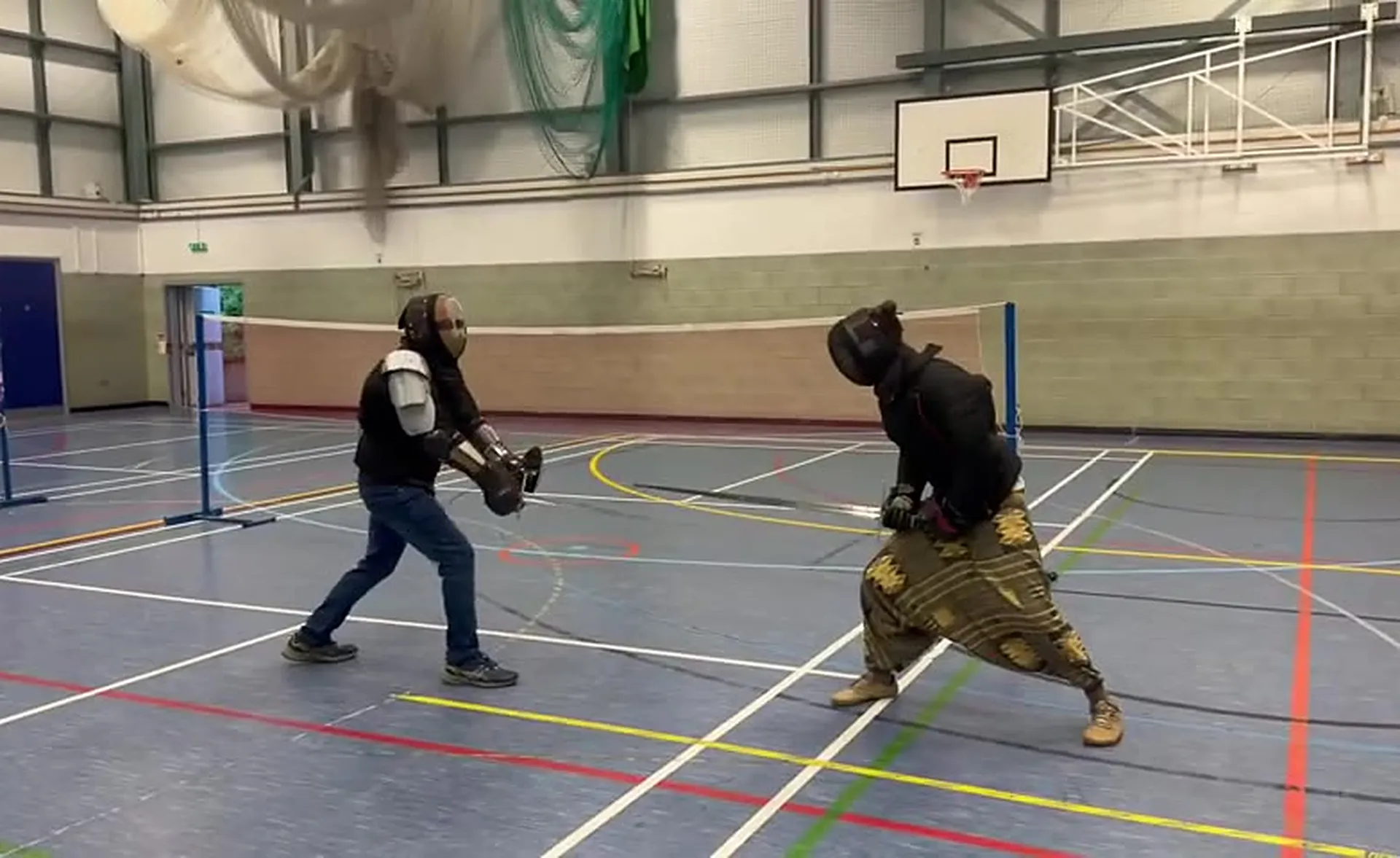
If you only learn one position from Royal Armouries MS I.33, learn halpschilt. It appears again and again in the book. The priest uses it, the scholar uses it, and so does Walpurgis in the final pages. It is the book's answer to almost everything.
The word is Middle German and means "half-shield".
What It Looks Like
In halpschilt you hold your sword and buckler together in front of you. The sword hand is close behind the buckler, so the buckler covers it. The blade points up and forward, angled across your body, with its edge towards your opponent. The two weapons act as one: the buckler protects the hand, and the sword protects everything the buckler does not.
It is compact and it is closed. There is very little to hit that is not covered by steel.
Why It Works
Two things make halpschilt so strong.
The first is that it protects the hand. In sword and buckler fighting, the sword hand is the nearest and most tempting target. A fighter who leaves the hand out on its own gets hit there. In halpschilt, the hand sits behind the buckler's boss and the blade covers the rest.
The second is that it is ready to bind. With the sword angled forward, any attack that comes in meets the blade early. From that contact, the fencer in halpschilt can keep control of the opponent's sword, and the fight moves onto their terms.
Halpschilt as a Besieging
In I.33, halpschilt is often used as an obsessio, a "besieging". The idea is that you do not wait for your opponent to attack from their ward. You step into a position in front of it that closes the line they want to use. If they are in sub brach, under the arm, ready to cut upward, your halpschilt is already where that cut would go. They have to change their plan, and in that change you act.
We have set out all seven of the book's wards in our post on the seven wards of I.33.
How the Fight Runs From It
A typical sequence goes something like this. From halpschilt the blades meet. The fencer keeps the bind, and then brings the buckler across onto the opponent's sword hand, trapping it. This trap is called the schiltslac, the shield-strike. With the opponent's sword hand pinned, the free sword goes in with a cut or a thrust.
It is short, simple and very hard to stop once it starts, which is why the book trusts it so much.
The Buckler Never Works Alone
The most important thing halpschilt teaches is the principle behind all good buckler fighting: the buckler and the sword move together. A beginner tends to hold the buckler out like a little wall and swing the sword around it. The priest in I.33 does the opposite. His weapons stay together, and each one covers the other.
Fiore dei Liberi would have recognised that idea. In his longsword the sword is your shield, and a good attack moves you from one guard to another so that you are covered as you strike. Different weapon, same wisdom.
Try It
Halpschilt is a lovely position to learn because you feel safe in it almost at once. If you would like to try it with a sword and buckler, read our sword and buckler page and then come along on a Tuesday. Your first lesson is free.