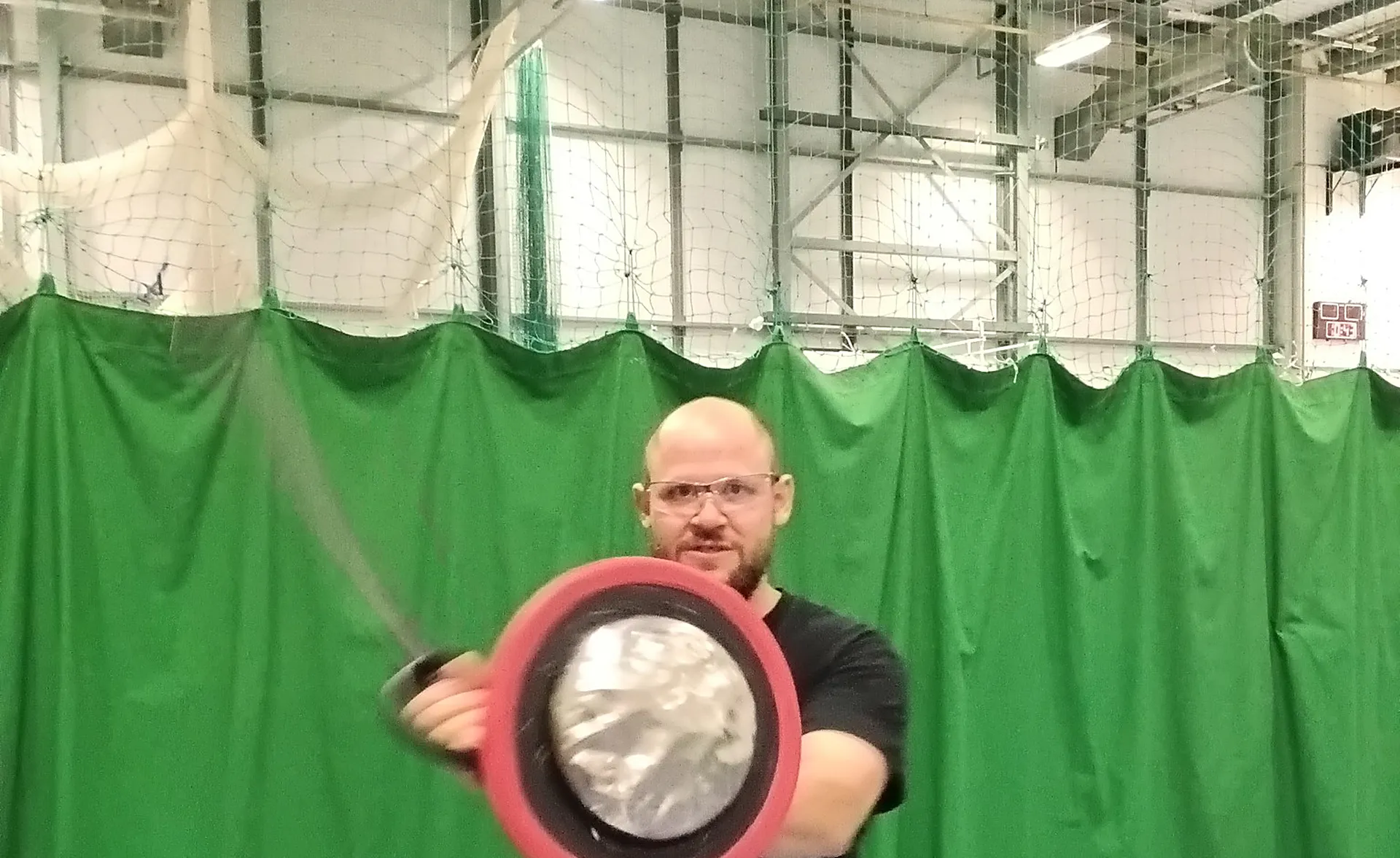
Pick up a good reproduction arming sword for the first time and you will probably laugh. It weighs about the same as a hardback book. Most people expect something that needs two hands and a run-up, and what they get is a blade that feels alive in one hand.
That surprise is the whole story of the arming sword. It was the everyday sword of the medieval knight for about four hundred years, and it was light because it had to be.
The Numbers
Surviving medieval arming swords usually weigh between 0.9 and 1.4 kilograms, which is roughly 2 to 3 pounds. A great many sit close to 1.1 kg. Overall length is usually somewhere around 85 to 100 cm, with a blade of 75 to 85 cm.
For comparison, a bag of sugar is 1 kg. A cricket bat is about 1.2 kg. A two-handed longsword is usually 1.3 to 1.8 kg. So the arming sword is lighter than a cricket bat and not much heavier than the sugar, and it was carried on the hip all day by people who expected to use it.
The sword historian Ewart Oakeshott sorted medieval blades into types by shape, and the arming sword covers most of his types X to XIV. The early ones, around 1000 to 1200, are broad cutting blades with a long fuller down the middle to save weight. Later types taper more sharply to a point, because armour was improving and the thrust was becoming more useful. The weight barely changes across all of them.
Why Arming Swords Were Light
A sword is a tool for moving quickly. The person holding it has to get the point or edge to a target, recover, cover themselves, and do it again, often wearing mail and carrying a shield or buckler in the other hand. Every extra 100 grams slows all of that down and tires the arm.
The smiths knew this. They put the weight where it helped and took it out everywhere else. The fuller removed steel from the middle of the blade without losing stiffness. The blade tapered in thickness towards the tip, so the point felt quick. The pommel sat at the other end as a counterweight, pulling the balance back towards the hand.
That balance matters more than the number on the scale. A good arming sword balances a few fingers in front of the crossguard, so it feels lighter than it is. A cheap replica with the same weight but a heavy tip feels like a club.
Where the Heavy Sword Myth Comes From
Films, games and Victorian writers did a lot of damage here. The idea of a knight heaving a huge blade around probably comes from three places.
The first is ceremonial and parade swords, which were made to be seen rather than used and could be heavy. The second is two-handed swords of the sixteenth century, which are a different weapon entirely. The third is simple guesswork: people assumed that anything made of steel and meant for war must be heavy, and nobody checked the museum catalogues.
When the Wallace Collection and the Royal Armouries started publishing weights, the myth should have died. It is still hanging on, which is why this post exists.
Arming Sword and Buckler
The arming sword's natural partner was a shield, and in civilian life a small round one called a buckler. The oldest fencing book in Europe, Royal Armouries MS I.33, is entirely about fighting with sword and buckler, and its swords are arming swords.
With a buckler in the other hand, a light sword makes even more sense. You are striking with one hand and covering with the other at the same time, so the sword has to move as fast as your wrist can turn it. We train sword and buckler at HEMA Penzance, and one of our members fights with it against longswords in sparring, which is always worth watching.
Arming Sword vs Longsword
People often ask which was better. They did different jobs. The arming sword was the sidearm, carried everywhere and used with a shield. The longsword came into its own in the fourteenth and fifteenth centuries, when plate armour meant a knight no longer needed a shield and could put both hands on a longer grip.
Fiore dei Liberi, the master we study, covers both. His longsword plays are the heart of the book, and he also teaches the sword in one hand, which is exactly the arming sword's world.
Feel One for Yourself
Numbers only go so far. The moment you hold a well-balanced sword, the myth goes out of your head for good. If you are anywhere near Penzance, come along on a Tuesday. Your first lesson is free and the club lends everything you need.